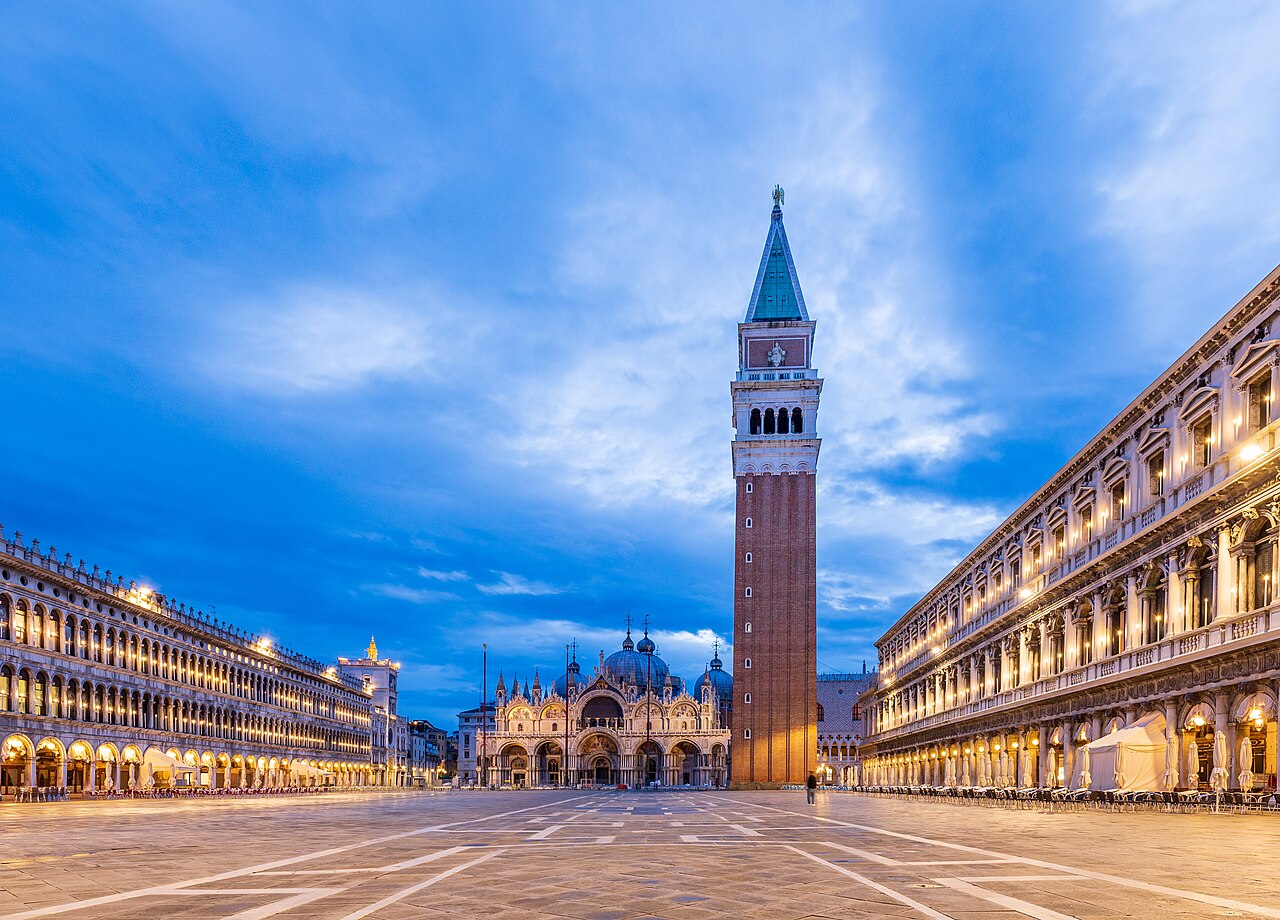


St Mark's Square
Ideal: Ideal for first-time Venice visitors, history, architecture, and classic city landmarks.
This is the only place in Venice called a piazza; the rest of the city's squares are campi. St Mark's relics in the basilica were smuggled from Alexandria in 828, hidden under a pile of pork so Muslim customs officers would not inspect them. The four bronze horses on the façade were looted from Constantinople in 1204 — those outside are copies, the originals displayed inside. The 98-metre bell tower collapsed on itself in 1902 and was rebuilt identically in 1912. As the city's lowest point, the square is the first place to flood during acqua alta.
Quick facts
- Built
- 9th century
- Architectural style
- Venetian Renaissance architecture
- Length
- 175 m
- Area
- 14,350 m²
Facts from Wikidata, photos from Wikimedia Commons.
Did you know?
Why does the square flood so often?
During the high tide known as acqua alta the square is one of the lowest points in Venice and floods first. The MOSE barrier system, operational since 2020, closes off the lagoon and now prevents most of these floods.
Is the bell tower original?
The present tower was completed in 1912. The original collapsed suddenly in 1902 — nobody died, but the loss shocked Venice, and the city rebuilt it "where it was, as it was", to the same design.
Where are the four bronze horses of the basilica?
The ones on the façade are replicas; the originals are displayed inside the basilica's museum to protect them from air pollution. They were taken from Constantinople in 1204, and Napoleon later carried them off to Paris for a while.
Why go?
- To see Venice's most important square and historic buildings
- To build a strong culture route around St Mark's Basilica and the Doge's Palace
- To feel Venice's crowded but enchanting city atmosphere
Travel tip
The square is much quieter early in the morning; crowds increase sharply by midday.