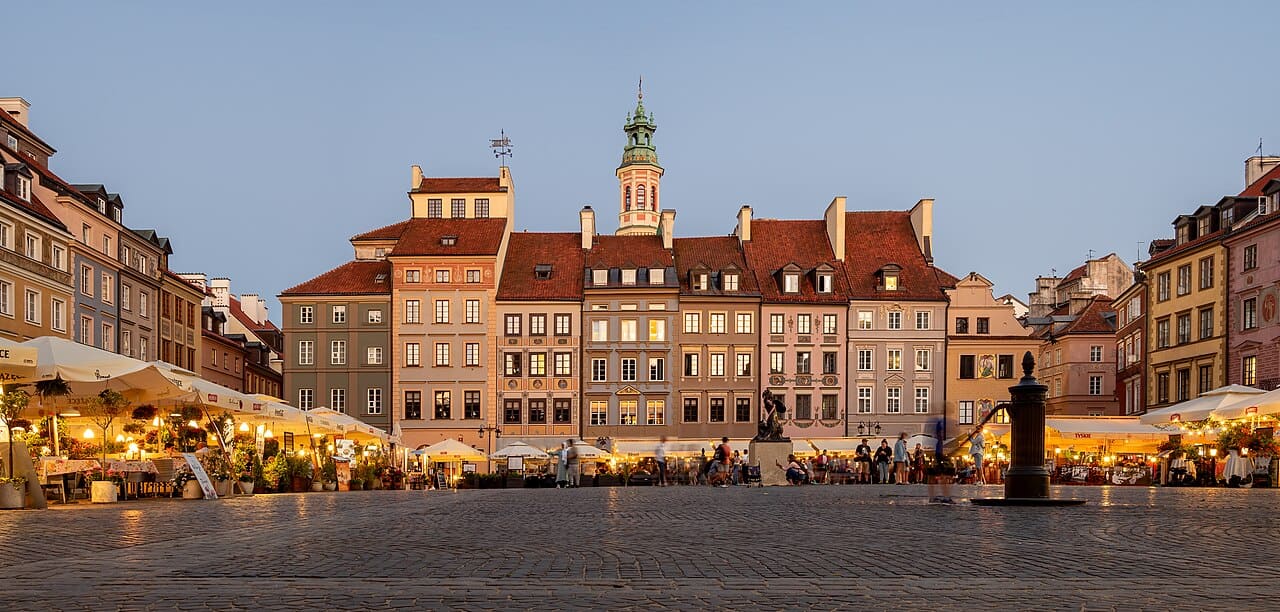


Warsaw Old Town
Ideal: Ideal for history, city walks, and first-time explorers of Warsaw.
None of the buildings you see survived the war: after the 1944 uprising, Hitler ordered the Old Town blown up street by street and roughly 85 percent of the city was destroyed. Reconstruction ran from 1945 to 1966, with architects reconstructing façade details from sources including Bernardo Bellotto's detailed 18th-century cityscape paintings. UNESCO normally does not list rebuilt areas; Warsaw became an exception in 1980 precisely because of the quality of that reconstruction work.
Quick facts
- Area
- 25.9 hectares
- Heritage status
- World Heritage Site
Facts from Wikidata, photos from Wikimedia Commons.
Did you know?
Is the old town actually old?
No. It was deliberately destroyed in 1944, with about 85% flattened. What stands today was rebuilt in the 1950s, largely using Bernardo Bellotto's 18th-century paintings and pre-war student survey drawings.
How did a rebuilt city get UNESCO status?
It was inscribed in 1980 on unusual grounds: what is protected is not the age of the buildings but a nation's determination to rebuild its cultural identity. The decision set an important precedent.
What happened to the Royal Castle clock?
The clock on the castle tower stopped at 11:15 when the building was bombed in 1939 and stayed frozen there for years. It was restarted after reconstruction, and that moment became a symbol of the city's memory.
Why go?
- To see the UNESCO-listed rebuilt historic city center
- To feel Warsaw's postwar rebirth story
- For a pleasant walk among squares, walls, and colorful façades
Travel tip
Combine the Old Town walk with the Royal Castle and Krakowskie Przedmieście route.