

Gothic Quarter
Ideal: Ideal for city walks, history, street photography, and local atmosphere.
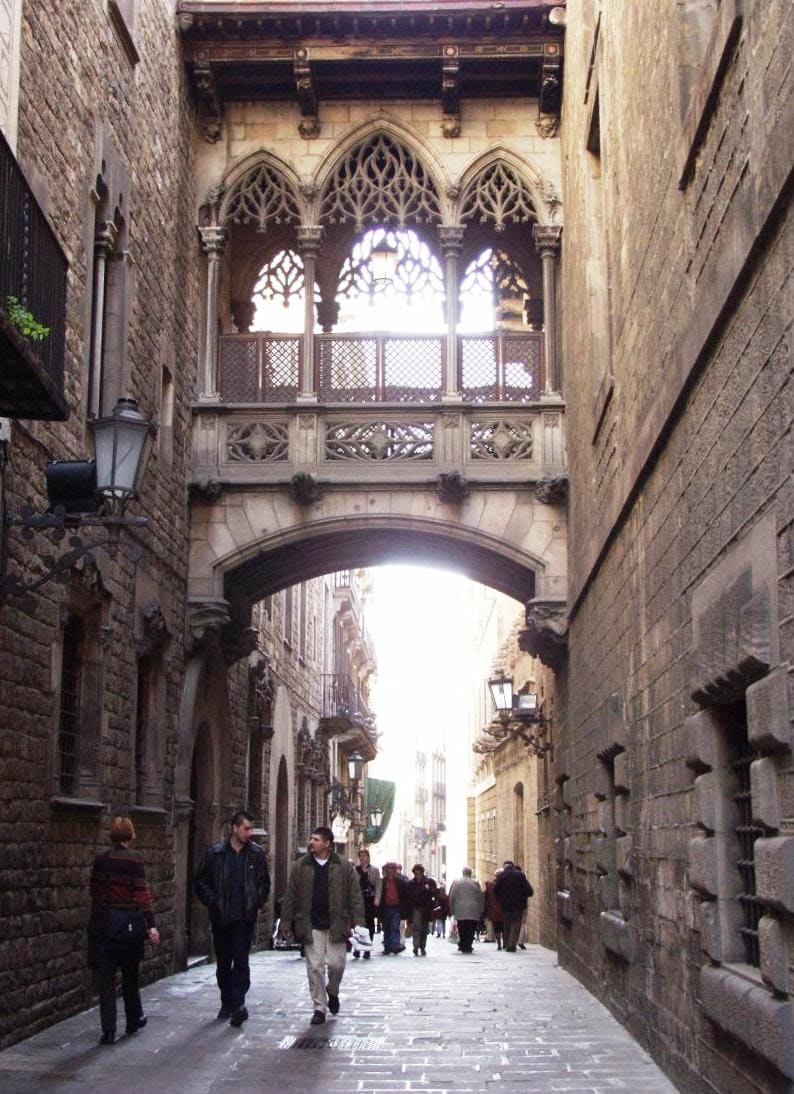
Beneath the neighbourhood lies Barcino, the Roman city founded around 15 BC; 4th-century wall sections still stand in side streets. But part of the 'medieval' look is stage dressing: the much-photographed neo-Gothic bridge on Carrer del Bisbe was added in 1928 before the 1929 World's Fair. Thirteen geese are always kept in the cathedral cloister — because the city's patron Eulalia is said to have been thirteen when she was killed.
Did you know?
Is the Gothic Quarter really medieval?
Partly. Some buildings genuinely are, but the quarter's "medieval" look was largely created in the run-up to the 1929 World's Fair — several Gothic façades were moved here from elsewhere and reassembled.
What lies beneath the quarter?
The Roman city of Barcino. Beneath the city history museum you can walk through some 4,000 m² of Roman streets, winemaking rooms and laundries.
What are the pockmarks on the walls?
On the wall of Plaça de Sant Felip Neri they are scars from a 1938 bombing that killed mostly children. Long assumed to be bullet holes, the square is now one of the city's most moving Civil War memorials.
Why go?
- To explore Barcelona's oldest and most atmospheric streets
- To walk among small squares, Gothic buildings, and local cafés
- For a more street-focused experience than classic tourist stops
Travel tip
Turn into side alleys; the real pleasure of the Gothic Quarter is in small passages, not main streets.