



Louvre Museum
Ideal: Ideal for art, history, museum, and culture route enthusiasts.
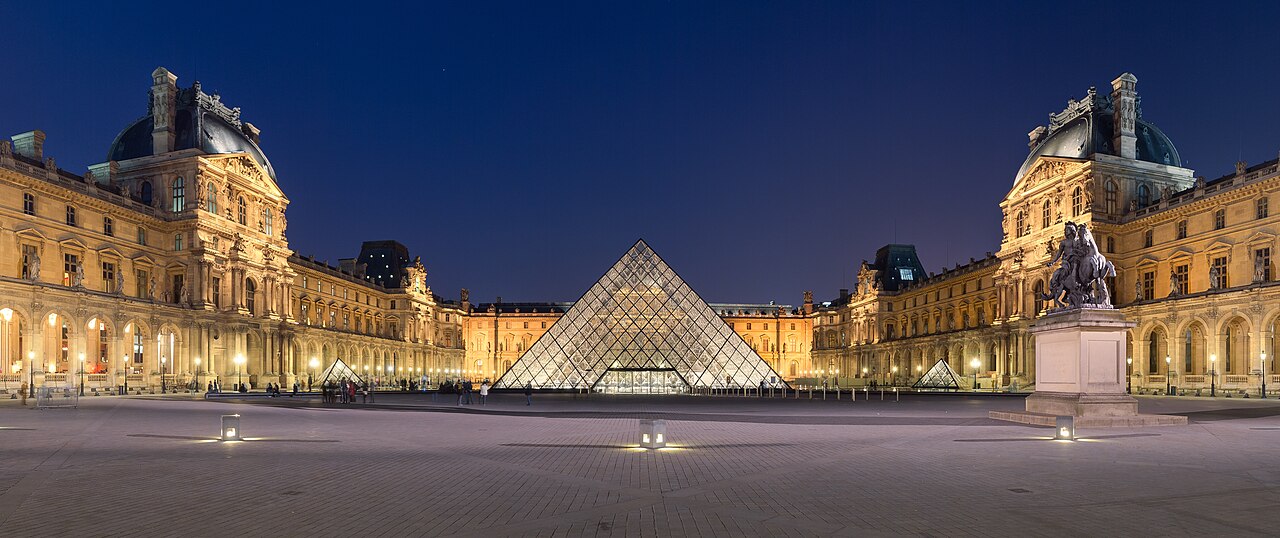
The building began in 1190 as Philippe Auguste's defensive fortress; medieval wall foundations can still be walked through in the basement today. Converted to a museum in 1793, it now displays roughly 35,000 of more than 380,000 works — spending ten seconds in front of each would take days. What made the Mona Lisa world-famous was an Italian employee walking out with it under his coat in 1911 and its two-year disappearance. The central glass pyramid was added by I. M. Pei in 1989 and consists of 673 glass panels.
Quick facts
- Built
- 10 August 1793
- Opened
- 10 August 1793
- Architect
- Pierre Lescot
- Area
- 210,000 m²
- Elevation
- 44 m
- Annual visitors
- 2.8 million
Facts from Wikidata, photos from Wikimedia Commons.
Did you know?
Was the Louvre always a museum?
No. It began as a fortress built by Philip II in the late 12th century to defend Paris. The medieval foundations can still be walked through in the basement; it only became a museum in 1793, after the French Revolution.
Why did the Mona Lisa become so famous?
Much of the fame dates from the 1911 theft. A museum employee stole the painting and it was missing for two years; crowds queued to see the empty wall and the worldwide press coverage turned it into a global icon.
What is underneath the glass pyramid?
The 1989 pyramid is not decoration but a fix: with entrances overwhelmed, a large reception hall was dug underground to distribute visitors to all wings. The pyramid also carries daylight down into that hall.
Why go?
- To see the Mona Lisa, Venus de Milo, and vast art collections
- To experience one of Paris's most important museum and culture stops
- To see the contrast between palace architecture and the modern glass pyramid
Travel tip
The Louvre is huge; choose a few sections in advance rather than trying to see everything.